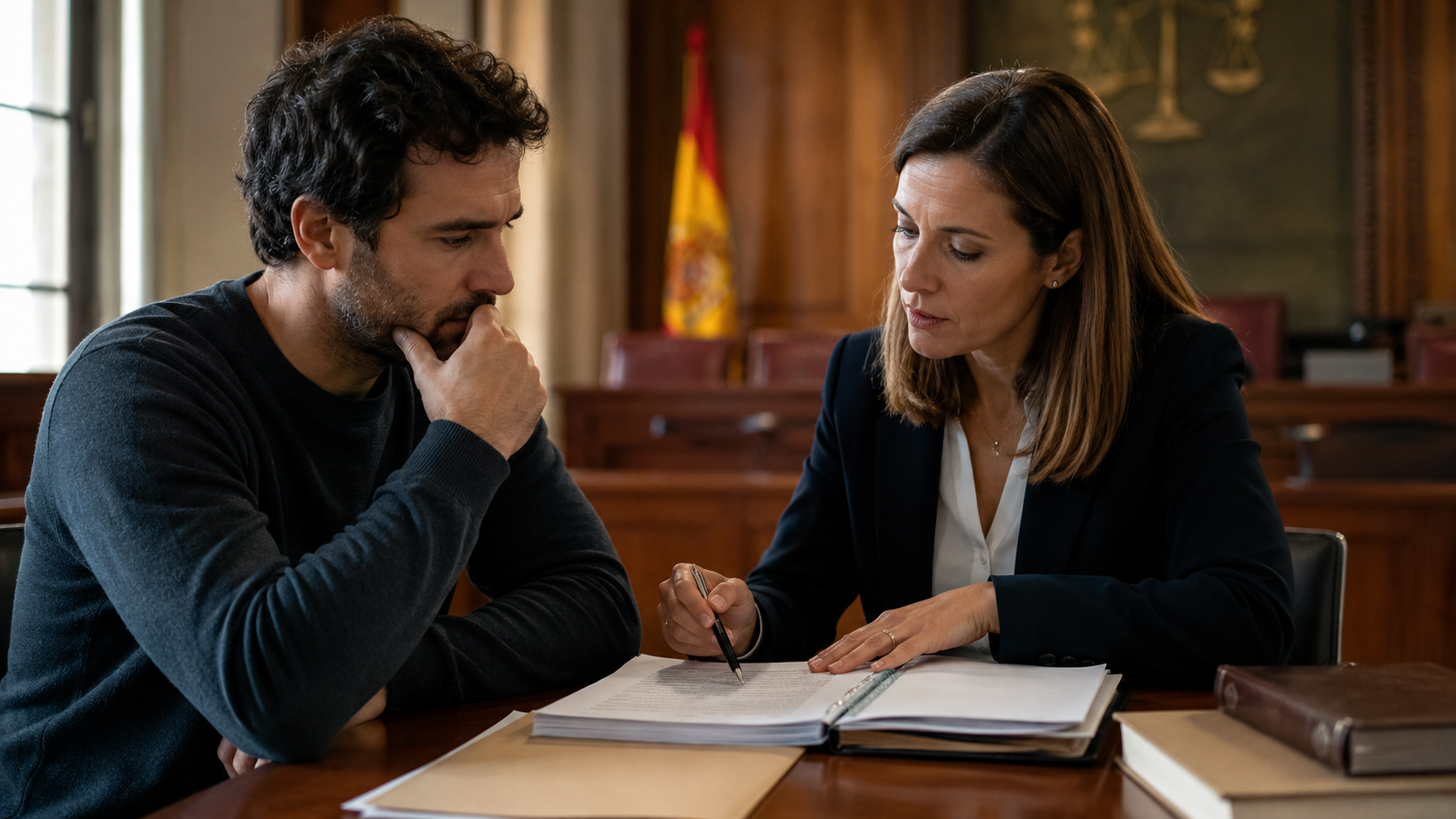
Suspect’s Statement in Spain: Rights and Defence
Suspect’s Statement in Spain: Rights and Defence
If you are wondering what to say in a suspect’s statement, the answer depends on a prior analysis that only your lawyer can carry out. Giving a statement without legal advice is one of the most common and costly mistakes in criminal proceedings. The person under investigation is not obliged to tell the truth, is not obliged to give a statement at all and has the right for their silence not to be interpreted against them. Knowing these limits before entering the courtroom may change the course of the entire proceedings.
What is a suspect’s statement and what rights apply?
A suspect’s statement is the procedural act whereby a person to whom the possible commission of a criminal offence is attributed appears before the investigating authority to answer questions from the judge, the public prosecutor and the private accusations. Unlike a witness, the person under investigation does not swear to tell the truth and cannot be punished for lying in their statement. Their legal position is radically different.
Article 24.2 of the Spanish Constitution recognises the right of the person under investigation not to make statements against themselves and not to confess guilt. Article 520 of the Spanish Criminal Procedure Act develops these rights at the police stage: the right to remain silent, the right not to take an oath and the right to legal assistance before any statement is made. At the judicial stage, those same rights remain fully in force.
Therefore, giving a statement is not compulsory. The person under investigation may refuse to answer some or all questions, may give a partial statement, or may reserve their version of events for the oral trial. None of these options may be interpreted as an indication of guilt. Silence in Spanish criminal proceedings is constitutionally protected and does not, by itself, generate adverse procedural consequences.
When does the person under investigation give a statement?
The statement may take place at different moments in the proceedings. The first statement before the police occurs at the time of arrest or at the police station, and it is the most dangerous. The second takes place before the investigating judge, during the investigation stage, when the court summons the person as a suspect. The third is the statement at the oral trial, now as the accused. Each has a different legal regime and a different role in the defence strategy.
The most delicate scenario is that of a person who gives a statement before the police without a lawyer or with a duty lawyer who does not know the case. In such cases, the person under investigation often believes that explaining the facts will help them. However, any detail they provide — a time, a location, a contradiction with existing evidence — may be used against them. In addition, what is stated before the police is recorded in the police report and may be confronted with later statements.
Another frequent situation is a court summons as a person under investigation without clear prior notice of the subject matter of the investigation. In these cases, the suspect appears without knowing what evidence exists against them. Therefore, giving a statement before knowing the case file is a mistake that no competent technical defence would allow.
Giving evidence at trial: a strategic decision
At the oral trial, the accused has the final opportunity to give their version directly to the court. However, giving evidence at that stage is also a strategic decision. If the prosecution evidence is weak, it may sometimes be advisable not to give evidence in order to avoid providing material to the prosecution. If there is a solid and coherent version, the statement may strengthen the defence. The lawyer must assess both options before the hearing, not during it.
How to prepare the suspect’s statement
Preparing the suspect’s statement is one of the most critical tasks in criminal defence. It requires, first of all, a full review of the case file in order to know what evidence exists, what contradictions it contains and what lines of questioning the prosecution may follow. Without that prior knowledge, any statement is a blind gamble.
Secondly, the lawyer must decide with the client whether it is advisable to give a statement or to exercise the right not to do so. That decision depends on the state of the evidence, the type of offence, whether the person under investigation has a coherent and verifiable version, and whether giving a statement adds anything to the defence that cannot be obtained by other means. There is no single answer: each case requires an individualised analysis.
At Fechenbach Abogados, David Fechenbach Marcos, ICAM No. 122770, personally prepares the statement strategy in each criminal case. Legal assistance for a judicial statement includes prior analysis of the case file, guidance on what to say in the suspect’s statement, preparation of answers to foreseeable questions and the decision as to whether it is advisable to give a statement. The firm operates in Madrid, Ibiza and Cádiz.
However, preparation does not end in the courtroom. After the statement, the lawyer must assess whether what has been said opens up new lines of defence or creates additional risks, and adjust the strategy for the following stages of the proceedings.
What happens if you give a statement unprepared?
Giving a statement without preparation is the most frequent and most difficult mistake to correct in criminal proceedings. What is said in the first statement is incorporated permanently into the case file. If later statements contradict what was said before, the prosecution will use that contradiction as an indication of lack of credibility. There is no way to withdraw a statement that has already been made.
In addition, many persons under investigation reveal in their statement information that the prosecution did not have or had not been able to prove by other means. A reference to a location, a date, a name or a detail that seemed minor may confirm a line of investigation that had stalled. Therefore, giving a statement without knowing the case file is equivalent to working for the prosecution.
Furthermore, a person under investigation who exercises the right not to give a statement before the police may later give a statement before the investigating judge, and vice versa. However, each change of position requires a strategic justification. Acting without a lawyer at the first statement and then trying to correct it later is a situation that the technical defence must handle very carefully so as not to aggravate the client’s position.
Contact Fechenbach Abogados
If you have received a summons as a person under investigation or you have to give a statement before the police or the court, Fechenbach Abogados can prepare your statement with you.
We provide assistance in Madrid, Ibiza and Cádiz. Contact us without obligation at fechenbach.es.