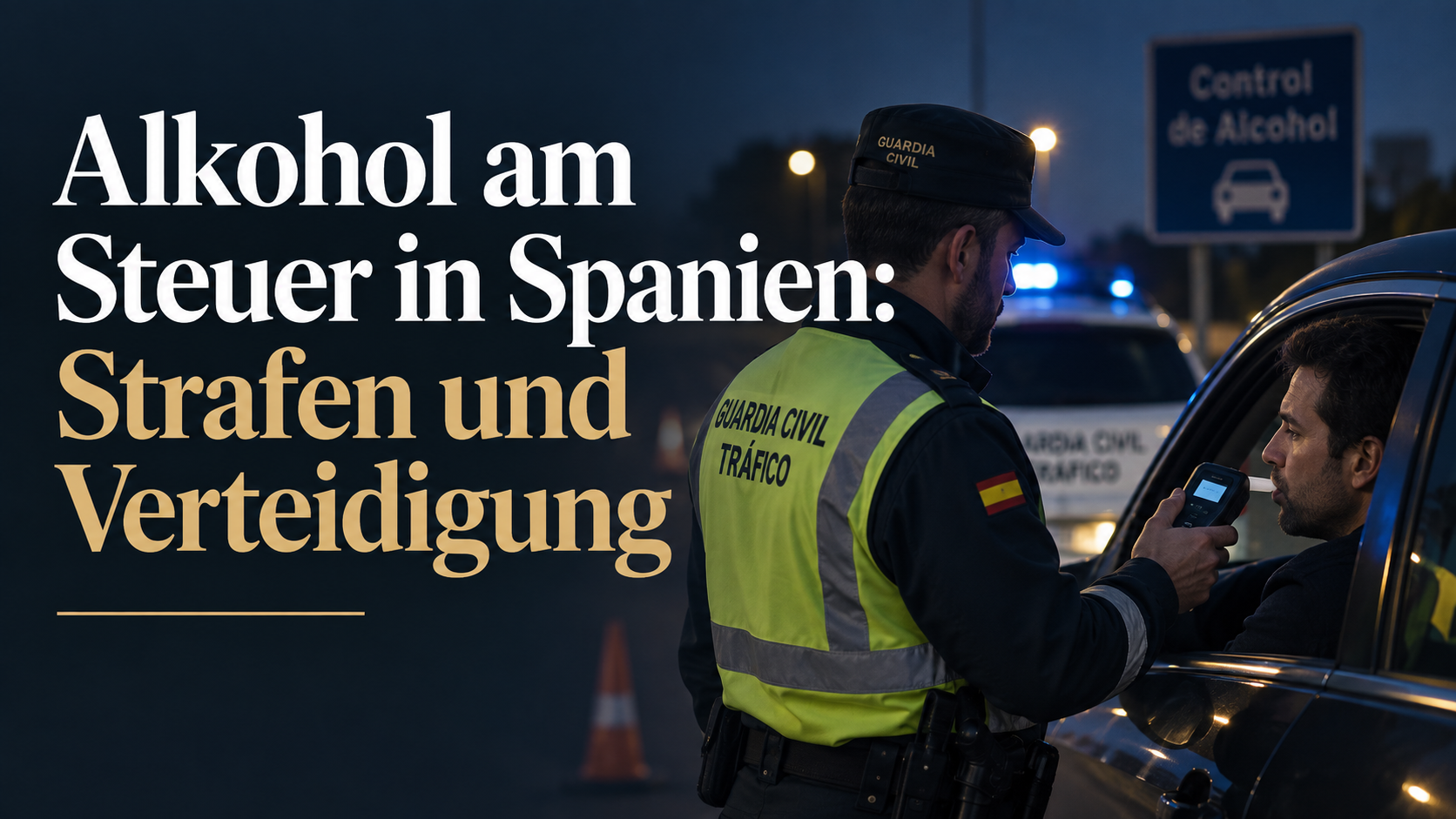
Drink Driving in Spain: Penalties and Defence
In Spain it is a criminal offence to drive with more than 0.60 milligrams of alcohol per litre of exhaled air or more than 1.2 grams per litre of blood. The penalty is three to six months’ imprisonment, a fine or community service, and in every case a driving ban of more than one and up to four years.
Stopped by the police in Spain: +34 652 28 99 82Message us on WhatsApp
From what level is it a criminal offence?
Article 379(2) of the Spanish Código Penal punishes anyone who drives a motor vehicle or moped under the influence of toxic drugs, narcotics, psychotropic substances or alcoholic drinks. It also provides that anyone who drives with more than 0.60 milligrams of alcohol per litre of exhaled air or more than 1.2 grams per litre of blood will be convicted in any event. This dual structure is what matters, and it is regularly misunderstood. Above those levels, criminal liability is tied to the reading, without any need to prove additional signs of impairment. Below those levels there may still be an offence, but only if impairment of the ability to drive is actually proven, for example through the manner of driving, the officers’ observations and the circumstances of the check. That is exactly where the defence comes in. Below the criminal threshold and without proven impairment, the matter remains an administrative infringement under the traffic and road safety rules. The difference is considerable, because it is the difference between a criminal record and a fine.
What penalties does the law provide for?
For the cases under Article 379, the law provides for alternative penalties, namely three to six months’ imprisonment, or a fine of six to twelve months, or community service of thirty-one to ninety days. In addition, in every case and without exception, there is a ban on driving motor vehicles and mopeds for more than one year and up to four years. Under Article 379(1), the same penalties apply to speeding by more than sixty kilometres per hour in built-up areas and more than eighty kilometres per hour outside them above the speed limit. For foreign clients, the problem is usually not the main penalty but the driving ban. A fine can be paid, but a driving ban of at least one year and one day changes your plans for life, especially if you have a second home in Mallorca or Ibiza. That is why the defence must aim at the length of the ban from the start and not just at the type of penalty.
What happens if I refuse the test?
Refusing is therefore usually the worse decision. The penalty range starts higher and offers no fine as an alternative. There is also a peculiarity that surprises many people. The Spanish Supreme Court has made clear that Article 383 created a special offence of disobedience that essentially protects the principle of authority and protects road safety only indirectly. The offence is therefore committed even where the person concerned refuses to cooperate out of annoyance, although they have not drunk a drop of alcohol and are in perfect condition (STS 475/2021 of 2 June). In practice this means you can commit an offence by refusing without having drunk anything. Arguing at the roadside about the lawfulness of the check is therefore the most expensive mistake in this area.
Have the test record and the police report reviewed in English
What more serious offences are there?
Article 380 punishes with six months to two years’ imprisonment and a driving ban of more than one and up to six years anyone who drives with manifest recklessness and thereby specifically endangers the life or physical integrity of others. Driving in the circumstances of the speeding offence and above the alcohol limits mentioned is expressly regarded as manifestly reckless. Article 381 goes further and punishes with two to five years’ imprisonment, a fine of twelve to twenty-four months and a driving ban of six to ten years anyone who drives in this way with manifest disregard for the lives of others. If no one was specifically endangered, the prison sentence is one to two years and the fine six to twelve months, with the same driving ban. Finally, Article 384 covers driving after losing all points, after a court-ordered provisional or final withdrawal of the licence, and driving without ever having obtained a licence. The penalty range is three to six months’ imprisonment, a fine of twelve to twenty-four months or community service of thirty-one to ninety days.
And if there has been an accident?
Then the rule on concurrent offences in Article 382 applies. Where the conduct punished under Articles 379, 380 and 381 results, beyond the danger, in harm that constitutes an offence, whatever its seriousness, the courts apply only the most severely punished offence, impose the penalty in its upper half and in every case award compensation for the civil damage caused. If a person dies, the focus shifts to negligent homicide, and the law classifies driving in the circumstances of Article 379 as gross negligence in every case. The penalty range is then completely different, and the defence must focus on causation and expert evidence from the very first hour.
What does this mean for my foreign driving licence?
Here I must draw a clear distinction, and I will also tell you where my statement ends. The Spanish court imposes a ban on driving motor vehicles in Spain. The consequences of a Spanish conviction for a licence issued in the UK, Ireland or another country depend on the law of the issuing state, and I do not comment on that without it being checked by a colleague qualified there. What I can tell you is this. At EU level, rules on the cross-border effect of driving bans have been adopted but are not yet in force. Once they take effect, the practical significance of Spanish driving bans for licences issued in other EU Member States would change considerably. Until then, the question is to be assessed under national law and should by no means be underestimated.
How do the proceedings work?
In Spain these cases are often dealt with in the speedy trial procedure, which can lead to a trial within a few days. For the person concerned this means two things. First, there is very little time. Second, there is the possibility of a plea agreement with the public prosecutor, which can lead to a reduced penalty. The decision on that should not, however, be taken on the spur of the moment in the court building. A plea agreement means an admission with an entry in the criminal record and a driving ban of at least one year and one day. Whether it makes sense depends on how reliable the test is, whether you were properly informed of your rights and whether an interpreter was called. That can only be assessed with the documents, and that requires a defence lawyer who has read them beforehand.
What you should do now
- Do not argue at the roadside and do not refuse the test, since refusal is a separate and more serious offence.
- Ask for the second test and have the results of both tests given to you in writing.
- Insist on an interpreter, even if you speak Spanish, and do not sign anything whose content you have not understood.
- Write down the time you were stopped, the times of both tests, the device number and the officers’ names.
- Keep all the documents handed to you, especially the test printout and the police report.
- Instruct a defence lawyer immediately, since speedy trials are scheduled within a few days.
- Decide on a plea agreement only after the file has been examined, and never under time pressure at the court.
Frequently asked questions
From what level is drink driving a criminal offence in Spain?
Under Article 379(2) of the Código Penal, anyone who drives with more than 0.60 milligrams of alcohol per litre of exhaled air or more than 1.2 grams per litre of blood will be convicted in any event.
Can I be convicted below these levels too?
Yes, but only if impairment is proven. The offence covers driving a vehicle under the influence of alcoholic drinks, and below the limits proof of impaired ability to drive is required.
What penalty do I actually face?
Three to six months’ imprisonment, or a fine of six to twelve months, or community service of thirty-one to ninety days, and in every case a driving ban of more than one and up to four years.
Is it better to refuse the test?
No. Under Article 383, refusal is a separate offence punishable by six months to one year’s imprisonment, with no fine as an alternative, plus a driving ban of more than one and up to four years.
Do I commit an offence if I have not been drinking and refuse?
Yes. According to the case law, this offence primarily protects the principle of authority, so it is committed even where the person concerned refuses out of annoyance although they have not drunk any alcohol.
What applies if there is an accident with injuries?
Under Article 382, only the most severely punished offence is applied, but the penalty is imposed in its upper half, together with an order to pay full compensation for the civil damage.
Does this affect my foreign driving licence?
The Spanish ban concerns driving vehicles in Spain. The consequences for a licence issued abroad depend on the law of the issuing state and must be checked separately there.
Call now on +34 652 28 99 82Describe your case in English
We defend English-speaking clients in Spanish criminal proceedings, including road traffic cases and speedy trials, with offices in Madrid, Palma de Mallorca, Ibiza and Alicante. We reply within 24 hours. See also Arrest in Spain and Criminal defence in Spain.
David Fechenbach Marcos, Managing Partner (Abogado Director) of Fechenbach Abogados, member of the Madrid Bar Association (ICAM) no. 122770 and associate lecturer in criminal procedure at the Universidad de Alcalá. Professional profile.
This article is for general information only and does not constitute legal advice. Every case requires an individual assessment.