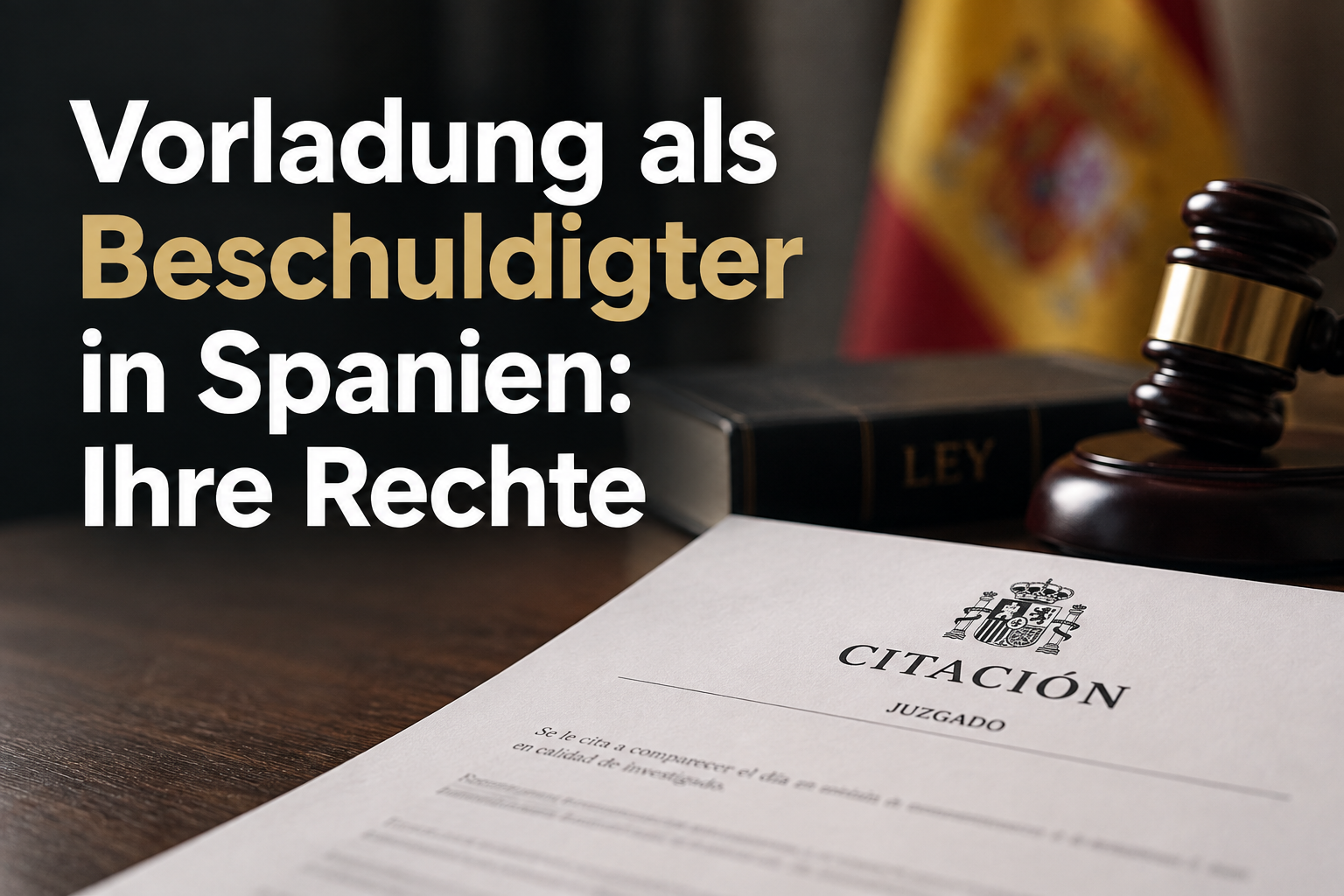
Summoned as a Suspect in Spain: Your Rights
A summons as an investigado means that criminal proceedings are under way in which an offence is attributed to you. It does not mean you have been charged or convicted. From that moment you have defence rights, the assistance of a lawyer is required, and you may inspect the file before your interview. You must attend.
Summons received: +34 652 28 99 82Send the summons by WhatsApp
What does investigado mean?
The term refers to the person to whom possible involvement in an offence is attributed in criminal proceedings. In 2015 it replaced the former term imputado; only the name changed, not the legal position. Investigado means neither guilty nor charged. The indictment is a later step and is brought by the prosecuting parties, not by the investigating judge. The summons is not a formality but a safeguard. Article 118(5) of the Ley de Enjuiciamiento Criminal requires the admission of a complaint or private prosecution, and any procedural step from which an accusation against a specific person results, to be brought to the attention of the presumed perpetrators without delay. And Article 488 requires the investigating judge to summon the persons against whom there are reasoned indications of involvement. A note on terminology. Since Ley Orgánica 1/2025, the former Juzgados de Instrucción no longer exist as single-judge courts. The investigation is now the responsibility of the Sección de Instrucción of the Tribunal de Instancia of the judicial district concerned.
Do I have to attend?
Yes, and this should be taken seriously. Under Article 486, the person to whom a criminal act is attributed is summoned solely to be heard, unless the law provides otherwise or their arrest is required. Article 487 sets out the consequence of non-appearance, namely that the summons may be converted into an arrest warrant if the person summoned does not appear and cannot prove a legitimate reason for not doing so. If you live abroad, are ill or have a conflicting appointment, that is no reason to stay away, but a reason to give notice in writing beforehand, provide proof and ask for a new date. What never works is waiting.
Do I need a defence lawyer, and when?
The assistance of a lawyer is required as soon as the file shows an accusation against a specific person. If no lawyer has been instructed, the Bar Association must be asked immediately to appoint one. According to the case law of the Tribunal Supremo, this right exists whatever the situation of the suspect and cannot be waived, in all types of proceedings. The decisive question is therefore not whether, but which defence lawyer. A lawyer appointed the same morning does not know the file. A lawyer instructed days in advance arrives with a strategy already decided. Also make use of the right to a confidential conversation with your lawyer, which expressly exists before the interview as well as immediately before and after it at the hearing itself. All communication with your defence lawyer is confidential.
Prepare the interview with an English-speaking lawyer
Access to the file and information about the accusation
Article 118(1)(b) grants the right to inspect the file in good time and in any event before the interview. The limit is the secrecy of the investigation under Article 302, which the judge may order to secure the success of the investigation or to prevent a serious risk to the life, liberty or physical integrity of others. If your file has been declared secret, the strategy changes fundamentally. As to the accusation itself, Article 118(1)(a) requires information in sufficient detail to allow an effective defence, and Article 775(1) requires the judge at the first hearing to inform you of the facts alleged in the most understandable form possible. The Spanish Constitutional Court has held insufficient a notice that was limited to naming the offence without specifying the conduct and that referred only vaguely to witness statements as evidence. Insufficient information is the subject of an objection that must be recorded at the hearing.
Make a statement or remain silent?
You may remain silent, leave some questions unanswered, refuse to incriminate yourself and refuse to plead guilty. Exercising this right may not be treated as evidence against you. Whether silence is the better choice depends on what is in the file. If your version is coherent and supported by documents, a statement can steer the investigation towards your exoneration at an early stage. If the file is thin or incomplete, a statement often serves to fill the gaps in the prosecution case. This decision is taken with the file in front of you, never according to a general rule. And one more warning from practice. Many clients attend convinced that the matter will be settled if they simply explain everything. That is not how a Spanish criminal investigation works. What you say is recorded and stays with your defence all the way to the trial, where contradictions with your first statement are systematically exploited.
The hearing itself
The court clerk informs you of your rights and asks you to give an address in Spain for service of documents or a person to receive them, with the warning that service at that address, in the cases provided for in Article 787.1 LECrim, allows the trial to take place in your absence. The judge then informs you of the facts alleged and the interview takes place, in which the public prosecutor and, where applicable, the private prosecution (acusación particular) also ask questions. At this hearing your defence lawyer can ask for evidence in your favour to be taken, and that is exactly the right moment to do so. If the subject of the investigation or the accusation changes significantly later on, you must be informed without delay.
What you should do now
- Write down the date, time, court and case number of the summons and keep it in full, including the envelope in which it was served.
- Instruct a defence lawyer now, so that the lawyer can be formally appointed and inspect the file before the interview.
- Gather documents that support your version, such as contracts, invoices, bank transfers, messages and medical reports, each with its date.
- Do not delete anything. Deleted messages or files are regularly discovered and count against you.
- Do not contact the complainant or possible witnesses.
- Ask for an interpreter, which is free of charge.
Frequently asked questions
Does this mean I have been charged?
No. The investigado is the person to whom an offence is attributed and who has defence rights from that moment. The indictment is brought later by the prosecuting parties, not by the investigating judge.
Do I have to attend the hearing?
Yes. If the person summoned does not appear and cannot prove a legitimate reason, the summons may be converted into an arrest warrant under Article 487 LECrim. Reasons for not attending must be proven in advance.
Do I really need a defence lawyer?
Yes. From the moment the file shows an accusation against a specific person, the assistance of a lawyer is required. The right exists whether or not the suspect is in custody.
Will I have access to the file before the interview?
Yes, unless secrecy has been ordered. The law grants the right to inspect the file in good time and in any event before the interview. The temporary restriction is governed by Article 302 LECrim.
May I remain silent?
Yes. You may remain silent, leave some questions unanswered, refuse to incriminate yourself and refuse to plead guilty. Whether silence makes tactical sense depends on what is in the file.
What is the address for service they ask me for?
At the first hearing you are asked to give an address in Spain or a person to receive documents. Service there allows, under the conditions of Article 787.1 LECrim , the trial to take place in your absence.
Call now on +34 652 28 99 82Describe your case in English
We defend English-speaking clients in Spanish criminal proceedings, in English, Spanish, German and Polish, with offices in Madrid, Palma de Mallorca, Ibiza and Alicante. We reply within 24 hours. See also Arrest in Spain and Pre-trial detention in Spain.
David Fechenbach Marcos, Managing Partner (Abogado Director) of Fechenbach Abogados, member of the Madrid Bar Association (ICAM) no. 122770 and associate lecturer in criminal procedure at the Universidad de Alcalá. Professional profile.
This article is for general information only and does not constitute legal advice. Every case requires an individual assessment.