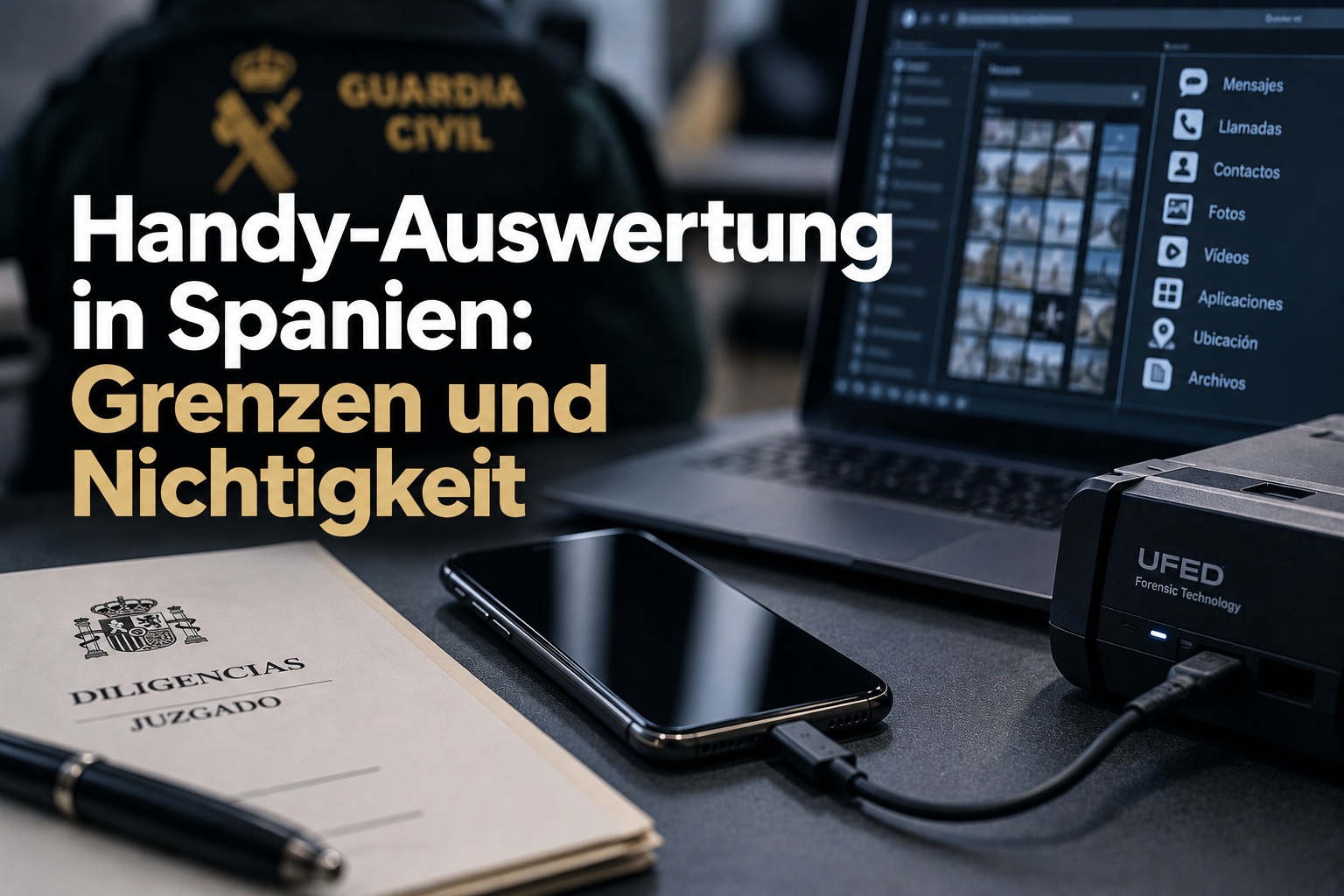
Phone Searches in Spain: Limits and Nullity
The fact that your phone was taken from you in Spain does not entitle anyone to read it. Seizure alone does not authorise access to the content. A separate, individually reasoned court decision is required, setting the scope and extent of the search.
Device seized: +34 652 28 99 82Message us on WhatsApp
Why is a phone more than an item of evidence?
In 2015 the Spanish legislature made it expressly clear that communication devices and mass storage devices are more than mere items of evidence, and derived from this the strict rules on access to their content. The reason is that a single device mixes data protected by the secrecy of communications, the right to privacy and data protection. This leads to a principle worth remembering. Where fundamental rights are concerned, it is not true that whoever may do more may also do less. Today, examining a USB stick can intrude further into privacy than searching an entire home.
Seizure does not authorise access
Article 588 sexies a(1) requires the court decision to give reasons also for accessing the information contained in the devices where the seizure of computers, phones or mass storage devices during a house search is foreseeable. Paragraph 2 makes clear that seizure alone does not authorise access to the content, without prejudice to later authorisation by the court. The same requirement applies outside the home. Article 588 sexies b extends it to devices seized independently of a house search, for example on an arrest in the street. The officers must report the seizure to the court, and if the court considers access essential, it grants the corresponding authorisation.
What must the court order contain?
Article 588 sexies c(1) lists three mandatory elements. The decision sets the scope and extent of the search, it may authorise copies of the data to be made, and it lays down the conditions needed to secure the integrity of the data and the guarantees for preserving them with a view to any expert examination. In addition, these measures are subject to the guiding principles of Article 588 bis a, namely speciality, suitability, exceptionality, necessity and proportionality. Speciality requires the measure to relate to a specific offence and prohibits measures aimed at uncovering offences or dispelling suspicions without an objective basis. This is precisely the point of attack against the complete mirroring of years of communications in proceedings concerning a single offence.
Have the order and the forensic report reviewed
Urgent access, the cloud and passwords
In urgent cases, Article 588 sexies c(4) allows the police to examine the data directly, but only where there is urgency and a legitimate constitutional interest that makes the measure essential. The court must be informed immediately, and in any event within 24 hours, in a reasoned written report stating the reasons, the measure taken, how it was carried out and its result. The court revokes or confirms it, giving reasons, within 72 hours at the most. Extension to other systems is governed by paragraph 3. It is permitted where there are reasoned grounds to believe that the data sought are stored in another system or part of one, provided they are lawfully accessible from or available to the original system. The extension requires court authorisation unless it was already included in the original order, and in urgent cases the same 24 and 72-hour time limits apply. Finally, on passwords, a safeguard that hardly anyone knows. Paragraph 5 does allow anyone who knows how the system works or the security measures to be required to cooperate, under threat of criminal liability for disobedience. But this provision expressly does not apply to the suspect, to persons exempt from the duty to testify because of family ties, or to those bound by professional secrecy under Article 416(2). If you are the suspect, you do not have to hand over your unlock code.
Will I get my device back?
The law prefers copying to retention. Under paragraph 2, seizure of the physical storage media is to be avoided where it may cause serious harm to the holder or owner and a copy can be made under conditions that guarantee the authenticity and integrity of the data, unless the device is the object or instrument of the offence or other reasons justify keeping it. A request for return can be based on this, especially if the device is your work tool or the mirroring has already been done. Make the request in writing and document the specific harm, rather than waiting for the device to be returned at the end of the proceedings.
What you should do now
- Have the decision authorising access located in the file and check whether it limits the scope, extent and time period.
- Establish whether the device was seized during a house search or elsewhere, because the steps required are different.
- In the case of urgent access, compare the date of notification to the court and the date of confirmation with the 24 and 72-hour time limits.
- Check how the device was recorded in the record, that is, make, model, IMEI and serial number, and whether they match the device examined.
- Request the complete forensic report including the hash values and compare the material produced with the authorised scope.
- Object expressly to any access going beyond the subject of the investigation and have the objection recorded.
Frequently asked questions
May my phone be examined just because it was seized?
No. The mere seizure of a device does not authorise access to its content. That access can only be authorised by a later, individually reasoned court decision.
What must the court order contain?
It sets the scope and extent of the search, may authorise copies of the data and must lay down the conditions that secure the integrity and preservation of the data for any expert examination.
Do I have to hand over my password?
No. The duty to cooperate expressly does not apply to the suspect, to relatives entitled to refuse to testify or to those bound by professional secrecy under Article 416(2) LECrim.
May the police access the data themselves in urgent cases?
Only where there is urgency and a legitimate constitutional interest that makes the measure essential. The court must be informed immediately, at the latest within 24 hours, and confirms or revokes the measure within 72 hours.
Can the search be extended to the cloud?
Only under certain conditions. There must be reasoned grounds to believe that the data sought are in another system, and they must be lawfully reachable from the original system. The extension requires court authorisation.
Will I get my device back?
The law requires seizure of the storage media to be avoided where it causes the holder serious harm and a copy with guarantees of authenticity and integrity is possible, unless the device is the object or instrument of the offence.
Call now on +34 652 28 99 82Describe your case in English
We regularly challenge digital evidence in Spanish criminal proceedings, working in English, Spanish, German and Polish, with offices in Madrid, Palma de Mallorca, Ibiza and Alicante. We reply within 24 hours. See also House searches in Spain.
David Fechenbach Marcos, Managing Partner (Abogado Director) of Fechenbach Abogados, member of the Madrid Bar Association (ICAM) no. 122770 and associate lecturer in criminal procedure at the Universidad de Alcalá. Professional profile.
This article is for general information only and does not constitute legal advice. Every case requires an individual assessment.