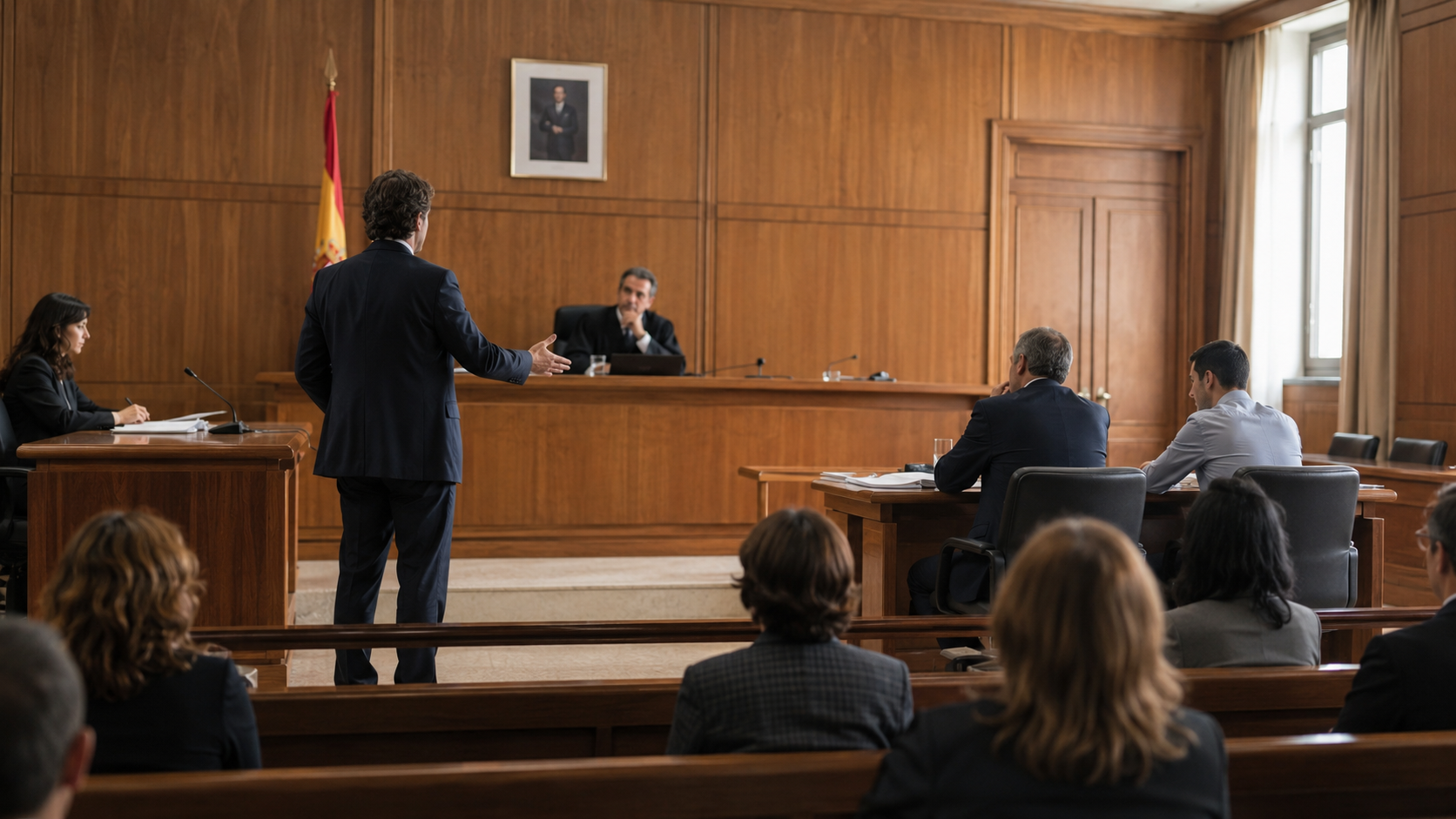
Criminal Trial in Spain: Stages, Duration and Defence
Criminal Trial in Spain: Stages, Duration and Defence
Receiving a summons to appear before the court and face the final procedural act of criminal proceedings creates uncertainty even for those who have already gone through previous stages. The criminal trial is the decisive moment in which evidence is heard, the parties’ positions are argued and judgment is delivered. Understanding its stages, its estimated duration and the real role of the defence lawyer is essential for anyone accused in criminal proceedings.
What is the criminal trial and where is it regulated?
The criminal trial is the procedural stage in which adversarial evidence is heard, final submissions are made and the court delivers judgment. Its main regulation is found in Article 786 of the Spanish Criminal Procedure Act. In addition, Articles 680 to 749 of the Criminal Procedure Act regulate ordinary proceedings, while Articles 785 to 794 of the Criminal Procedure Act regulate abbreviated proceedings.
It is therefore not a mere formal appearance: it is the procedural act in which criminal liability is determined. It should be noted that it is governed by the principles of orality, publicity, immediacy, adversarial proceedings and concentration. These principles are constitutional guarantees recognised in Article 120 of the Spanish Constitution.
Consequently, the court may only assess the evidence produced in its presence during the trial hearing. Unlike the investigation stage, in the trial stage the investigative measures previously carried out do not, by themselves, form the basis of the judgment. For that reason, the evidential strategy must be specifically designed for this stage.
Furthermore, the criminal trial is public except in legally defined cases: protection of victims, minors or reasons of public order. However, the full recording of the hearing ensures its later review on appeal. The procedural strategy must therefore assess the public significance of each procedural step.
Stages of the criminal trial and practical situations in court
In court practice, the conduct of a criminal trial follows a predetermined structure. The hearing begins with the preliminary issues under Article 786.2 of the Spanish Criminal Procedure Act: nullities, jurisdiction, violations of fundamental rights or grounds for adjournment. This is therefore the appropriate procedural moment to challenge evidence obtained in breach of procedural guarantees.
Once the preliminary issues have been resolved, the court opens the trial hearing with the reading of the prosecution and defence briefs. Evidence is then heard: the defendant’s statement, witness evidence, expert evidence, documentary evidence and, where appropriate, identification or recognition procedures. In these cases, the order in which the evidence is heard may affect its evidential effectiveness.
Another common stage is that of final conclusions. The prosecution and the defence amend or confirm their provisional legal classifications after the evidence has been heard. At this point, the criminal defence lawyer must assess whether to introduce mitigating circumstances, modify the degree of participation or reinforce the request for acquittal.
The most critical moment: examination of the defendant
The examination of the defendant at the criminal trial concentrates a substantial part of the defence strategy. Therefore, the decision whether to give evidence or to rely on the right under Article 24.2 of the Spanish Constitution must be assessed technically with the lawyer.
It should be noted that contradictions with previous statements may be used by the prosecution pursuant to Article 714 of the Spanish Criminal Procedure Act. In these cases, prior preparation of the client and full command of the case file are decisive in maintaining a coherent position in court.
How the defence lawyer acts and what they contribute at trial
The intervention of the criminal defence lawyer at trial is decisive. Their work begins long before the hearing: studying the case file, identifying lines of defence, preparing defence witnesses and designing the cross-examination of prosecution witnesses.
In court, the criminal defence lawyer therefore operates on three simultaneous levels. The first is the technical defence: raising preliminary issues, challenging documentary evidence and objecting to the admission of irregular evidence. The second is the evidential strategy: direct examination of defence witnesses, cross-examination of prosecution witnesses and the submission of expert evidence.
At Fechenbach Abogados, we regularly handle this procedural stage. David Fechenbach Marcos, criminal defence lawyer registered with the Madrid Bar Association, ICAM No. 122770, conducts criminal trials in abbreviated proceedings, ordinary proceedings and before the Jury Court. Each hearing requires individualised preparation of the case file and of the witnesses.
The third level is the closing speech. In the final oral submissions, the criminal defence lawyer presents the conclusions, assesses the evidence heard at trial and requests acquittal or, in the alternative, the application of mitigating circumstances. Consequently, the closing speech is not improvised: it is built on the evidence actually produced in court.
However, not every strategic decision is made in the courtroom. A supervening plea agreement under Article 787 of the Spanish Criminal Procedure Act may also be considered if favourable procedural circumstances arise during the hearing.
Consequences of facing trial without specialised defence
Facing a criminal trial without specialised technical defence seriously compromises any procedural strategy. The preliminary issues under Article 786.2 of the Spanish Criminal Procedure Act must be raised at the appropriate procedural moment. Therefore, a technical omission at this preclusive stage may prevent later review on appeal.
In addition, procedural deadlines are strict. The summons is served in advance, but the defence brief requires prior preparation: proposal of evidence, precise legal classification and documentary organisation. However, attending trial without having controlled these procedural milestones severely limits the real chances of success.
Consequently, a conviction results in a criminal record in the Central Register of Convicted Persons. It should be noted that such records may affect future administrative authorisations, public examinations, immigration proceedings or employment processes. For this reason, specialised legal assistance from the investigation stage makes it possible to reach trial with a consolidated strategy.
Contact Fechenbach Abogados
If you have a criminal trial scheduled, Fechenbach Abogados can analyse your case with technical rigour before the hearing.
We have offices in Madrid, Ibiza and Cádiz. Contact us without obligation and we will prepare with you the most appropriate procedural strategy for your situation.