Chain of Custody in Criminal Proceedings: Challenging Evidence
Chain of Custody in Criminal Proceedings: Challenging Evidence
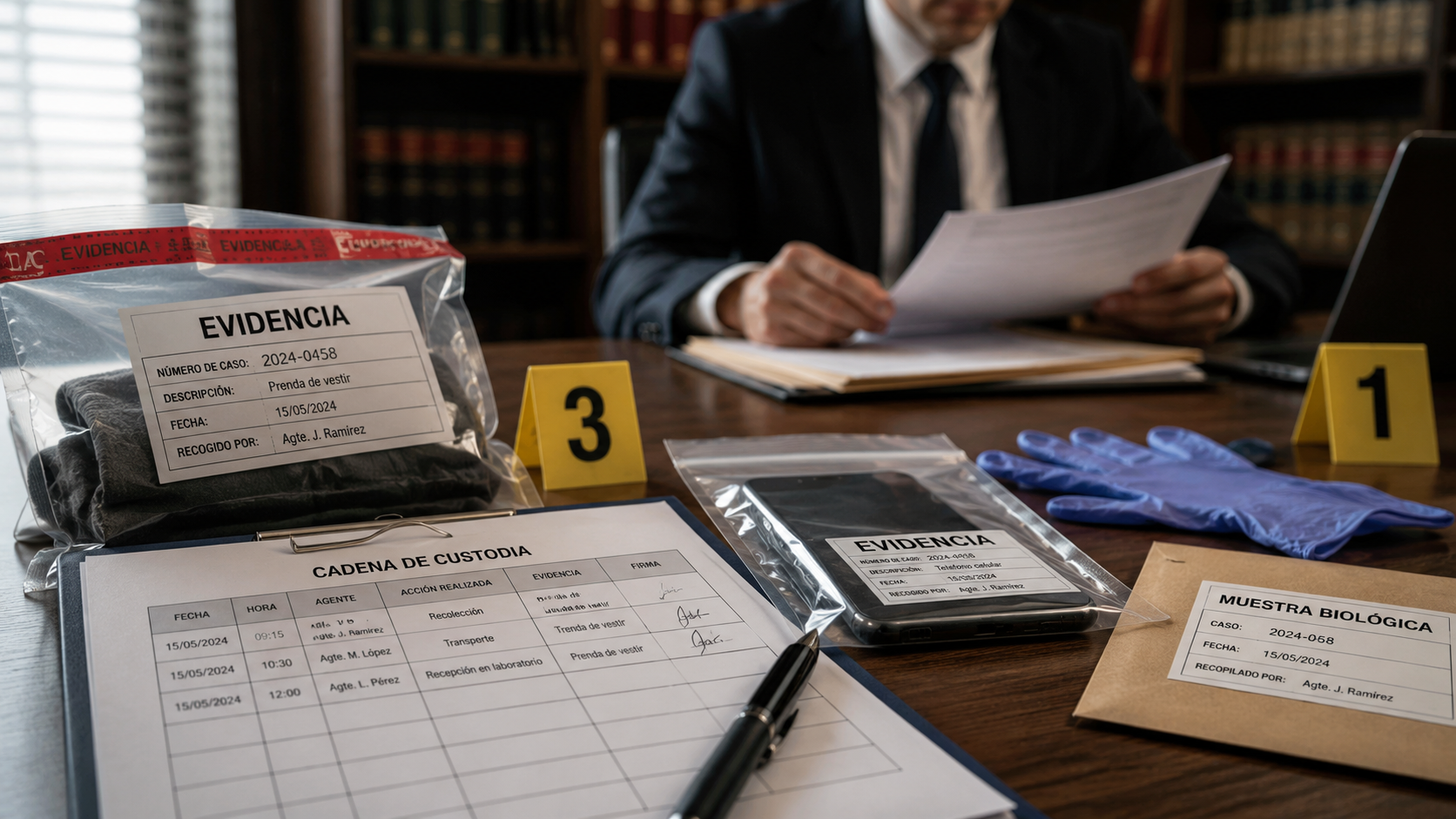
A drug analysis without identification of the officer who transported the substance, a DNA sample without an evidential seal, or an electronic device handled without a seizure record may undermine the entire prosecution case.
The chain of custody is the procedure that ensures that the evidence presented at trial is the same evidence that was obtained at the scene of the events. Knowing its rules and the points at which it may be broken is decisive for anyone under investigation in criminal proceedings.
What is the chain of custody and what is its legal basis?
The chain of custody is the set of documented actions that prove the traceability of evidence from the moment it is collected at the scene of the events until it is assessed by the court. It therefore guarantees that the sample analysed by the expert is the same as the one actually seized.
Its legal basis is found in Article 334 of the Spanish Criminal Procedure Act, which regulates the collection and custody of the effects of the offence. In addition, Articles 326 and 338 of the Criminal Procedure Act establish the requirements for visual inspection, identification and transfer of the items of evidence.
It should be noted that the chain of custody is not a mere administrative formality. It is a procedural guarantee directly connected to the right to the presumption of innocence under Article 24.2 of the Spanish Constitution. Consequently, a breach of the chain of custody may affect the evidential value of the seized item.
Unlike nullities arising from violations of fundamental rights, a break in the chain of custody does not automatically render the evidence null and void. However, it may deprive the evidence of probative force if the defence proves that there are reasonable doubts as to the identity or integrity of the object analysed. Therefore, technical control of the chain of custody forms an essential part of the defence strategy.
Practical situations where the chain of custody may be broken
In court practice, the scenarios in which a break in the chain of custody is alleged are numerous and easily identifiable. The first arises in drug trafficking offences: substances seized without a signed record, transfers to the laboratory without identification of the officer involved, or weighing procedures carried out without the presence of the person under investigation.
Incidents also frequently arise in relation to biological evidence. For example, DNA samples obtained at a crime scene, collected without numbered seals or preserved in inadequate conditions. In such cases, the defence must analyse the full route followed by the sample from collection to the expert report.
Another common scenario concerns seized electronic devices. Mobile phones, computers or hard drives seized without prior forensic imaging, without a seal signed by witnesses or without a detailed record may raise doubts about the integrity of the information extracted.
The most frequent case: samples in drug-related offences
The evidential integrity of narcotic substances is one of the most recurring issues in criminal trials. In these cases, the police report, weighing records, referral letters to the National Institute of Toxicology and final reports are examined.
Therefore, if the signature of the custody officer is missing, if the seals do not match or if the number of packages varies between procedural acts, the defence may challenge the expert result with consistent technical arguments.
How the chain of custody is challenged and what a criminal defence lawyer contributes
The technical challenge of the chain of custody requires an exhaustive documentary analysis. The criminal defence lawyer reviews the police report, seizure records, referral documents, entry logs at police premises and expert reports. Based on that examination, the lawyer identifies the points at which traceability presents gaps or contradictions.
Consequently, the defence may request witness evidence from the officers involved in each link of the chain. It may also propose a contradictory expert report challenging the identity or integrity of the analysed sample. The challenge is formally raised in the defence brief and reiterated as a preliminary issue at the beginning of the oral trial.
At Fechenbach Abogados, we regularly work on this line of technical defence. David Fechenbach Marcos, criminal defence lawyer registered with the Madrid Bar Association, ICAM No. 122770, conducts proceedings in which the chain of custody has proved decisive for the final outcome of the trial. Each case requires an individualised study of the documents contained in the case file.
However, it is not enough merely to allege the existence of formal irregularities. Case law requires proof that those defects create reasonable doubts about the identity of the object analysed. Therefore, the defence must raise the challenge with evidential rigour and connect it to the specific impact on the right to the presumption of innocence.
Consequences of failing to challenge custody defects in time
Failing to detect irregularities in the chain of custody in time has significant procedural consequences. If the challenge is not raised at the appropriate procedural moment, the court may consider the debate to be precluded. As a result, formal defects may be deemed cured and the expert report may enter the trial with full evidential force.
In addition, procedural deadlines are strict. Article 786.2 of the Spanish Criminal Procedure Act limits the raising of preliminary issues to the beginning of the oral trial in abbreviated proceedings. However, intervention from the investigation stage makes it possible to request supplementary investigative measures, appoint defence experts and build the challenge on a solid documentary basis.
Consequently, specialised legal assistance from the outset is decisive. A late defence loses procedural tools that cannot be recovered at later stages. For this reason, it is advisable to rely on a criminal defence lawyer who controls evidential traceability from the first police step.
Contact Fechenbach Abogados
If you are under investigation in criminal proceedings involving decisive expert evidence, Fechenbach Abogados can analyse your case with technical rigour.
We have offices in Madrid, Ibiza and Cádiz. Contact us without obligation and we will assess the available grounds for challenging the evidence in your case.